How to Choose a Web Design Company for Your Small Business in 2026

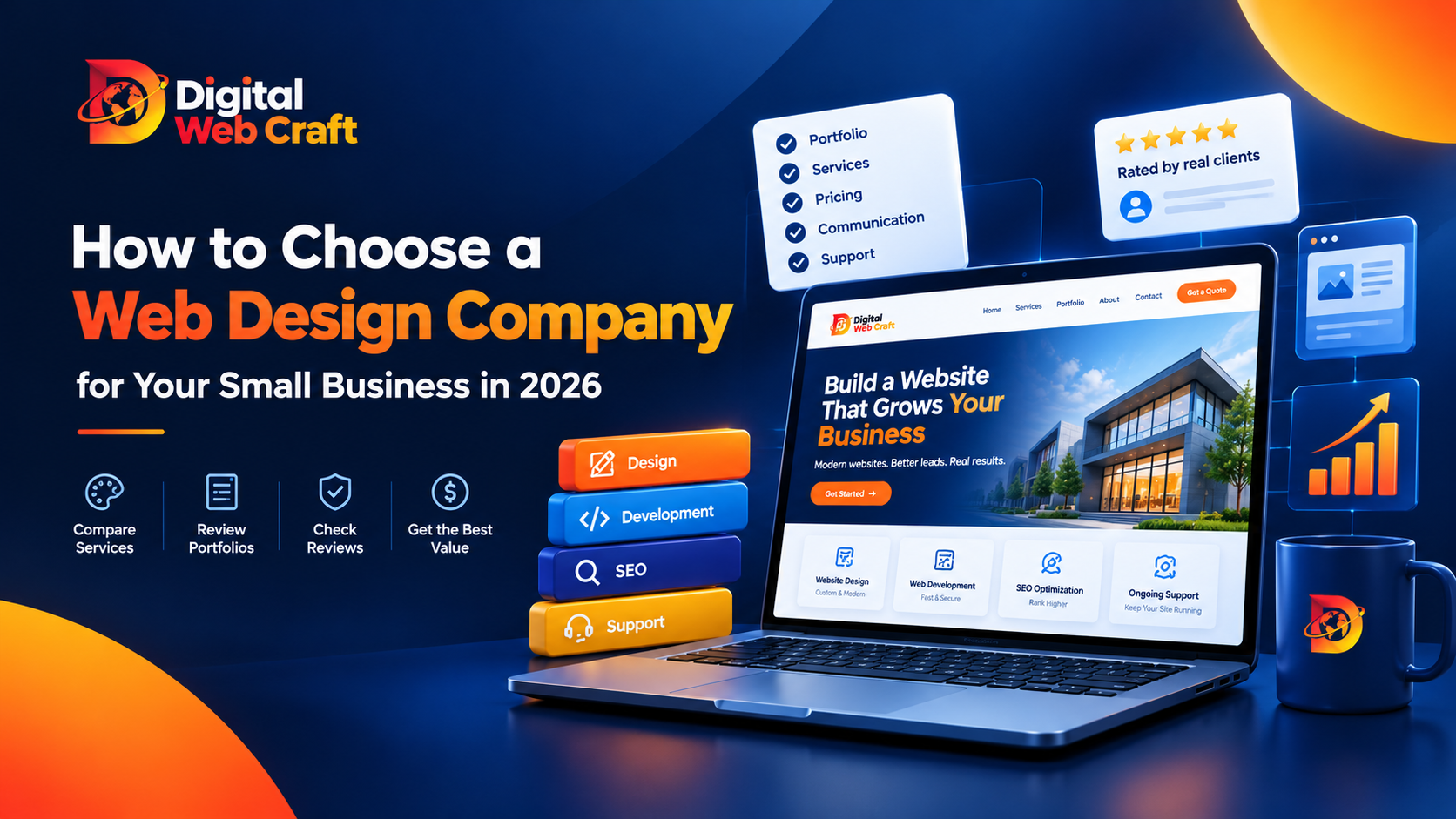
Choosing a web design company can feel overwhelming when every agency promises a beautiful website, better rankings, and more customers. But how do you know which provider can actually deliver what your business needs?
For a small business in the United States, the right website can make it easier for potential customers to discover your services, understand your value, and contact you. The wrong choice can leave you with an expensive website that looks attractive but fails to generate meaningful inquiries.
The difference often comes down to more than design. You need a team that understands your business goals, target audience, website functionality, search engine optimization, and the customer journey.
In this guide, you’ll learn how to choose a web design company in 2026, what to look for in a portfolio, which questions to ask before signing a contract, and how to avoid common mistakes that cost small businesses time and money.
Why Choosing the Right Web Design Company Matters
Your website is often one of the first places potential customers visit when researching your business. They may compare your services with competitors, review your portfolio, check your contact information, and decide whether your company appears trustworthy.
A professionally developed website can support these decisions by making information easy to find and providing clear next steps.
However, not every website project requires the same approach. A local contractor may need service pages, customer reviews, and a quote request form. An online retailer may need product management, secure checkout, shipping configuration, and inventory integrations.
Before contacting a web design company, identify what your website must accomplish.
Common business goals include:
- Generating qualified leads and quote requests.
- Increasing phone calls and consultation bookings.
- Selling products or services online.
- Improving brand credibility.
- Attracting customers through organic search.
- Showcasing projects, case studies, or customer results.
- Supporting existing customers with useful resources.
When your goals are clear, you can evaluate potential providers based on their ability to meet your requirements instead of choosing solely on appearance or price.
1. Define Your Website Goals Before Hiring an Agency
One of the most common mistakes small businesses make is contacting developers without knowing what they need.
You don’t need a technical specification document, but you should have a clear idea of the outcome you want.
Identify Your Primary Conversion Goal
A conversion is an action that matters to your business. Depending on your model, it might be a completed inquiry form, a phone call, a purchase, or a consultation booking.
For example, a plumbing company may prioritize emergency calls and service estimates. A consulting firm may want visitors to book discovery calls. A local retailer may need directions, store hours, and product information.
Your website structure should support those actions.
List Essential Features
Create two lists before requesting proposals.
Essential features:
- Mobile-friendly page layouts.
- Clear service or product information.
- Contact details and functional forms.
- Strong calls to action.
- Basic technical and on-page SEO.
- Analytics and conversion tracking where appropriate.
Optional features:
- Advanced animations.
- Custom customer dashboards.
- Complex chatbot integrations.
- Extensive personalization.
- Specialized third-party integrations.
Separating essential requirements from optional features makes it easier to control your budget.
Understand Your Target Audience
Think about your ideal customer, the problems they want to solve, and the information they need before contacting you.
A web design company should be able to translate those insights into useful page layouts, navigation, messaging, and conversion paths.
The goal is not simply to create a website that looks good to you. It is to create an experience that makes sense to the people you want to reach.
2. Review the Company’s Portfolio and Relevant Experience
A portfolio helps you understand a company’s design quality, technical capabilities, and experience with different types of projects.
However, don’t judge an agency entirely by its most attractive screenshot.
Look for Projects Similar to Yours
If you run a professional services business, look for examples involving service pages, lead forms, testimonials, and consultation booking.
If you operate an online store, examine the agency’s eCommerce work, product navigation, checkout experience, and mobile layouts.
Relevant experience can reduce uncertainty because the provider may already understand some of the challenges your project will involve.
Evaluate More Than Visual Design
When reviewing a portfolio, ask these questions:
- Is the website easy to navigate?
- Does the mobile layout work well?
- Are services or products explained clearly?
- Can visitors quickly find contact information?
- Are calls to action visible without overwhelming the page?
- Do the pages load reasonably quickly?
- Does the website appear consistent with the business’s brand?
Whenever possible, visit the live websites rather than relying exclusively on screenshots.
Ask About the Agency’s Role
Some agencies design websites but outsource development. Others handle strategy, design, development, content, and SEO internally.
Neither arrangement is automatically better, but you should know who will be responsible for each part of your project.
Ask the company to explain its role in the portfolio examples it presents. This helps you distinguish work it completed from work performed by another team.
3. Check Client Reviews and Reputation
Client reviews can reveal how a company communicates, handles revisions, meets deadlines, and responds when problems arise.
Look beyond the overall rating.
What Should You Look for in Reviews?
Pay attention to repeated comments about:
- Communication and responsiveness.
- Project management.
- Delivery against agreed timelines.
- Quality of development and testing.
- Handling of unexpected issues.
- Post-launch support.
- Transparency around pricing.
A company with a polished portfolio but repeated complaints about missed deadlines may not be the right choice for a time-sensitive project.
Ask for References When Appropriate
For a larger investment, consider asking for references from previous clients with similar projects.
Useful questions include:
- Was the project delivered within the agreed scope?
- Were unexpected costs explained clearly?
- Did the website work as expected after launch?
- Was support available when issues appeared?
- What would you do differently if you hired the company again?
Independent reviews, live websites, and direct references can provide a more complete picture than marketing claims alone.
4. Compare Web Design Pricing and What’s Included
Website pricing varies according to complexity, functionality, content requirements, provider experience, and the level of ongoing support.
A low quote is not necessarily a bargain if essential services are excluded. A high quote is not automatically better if it includes features your business does not need.
The following ranges are general planning estimates for US small businesses, not fixed market averages or guaranteed quotes.
| Website Project | Indicative Cost | Suitable For |
|---|---|---|
| DIY website builder | $100–$800 initially | Very simple websites |
| Basic professional website | $1,000–$3,000 | Small businesses needing an online presence |
| Custom business website | $3,000–$8,000 | Businesses needing tailored design and functionality |
| Lead-generation website | $2,500–$7,500 | Service businesses focused on inquiries |
| Small eCommerce website | $3,000–$10,000+ | Businesses selling products online |
| Advanced custom platform | $10,000–$25,000+ | Complex workflows and integrations |
Actual costs may fall outside these ranges depending on the project scope.
Request an Itemized Proposal
Ask each company to specify what the price includes.
A useful proposal should clarify:
- Number of pages and templates.
- Design and development responsibilities.
- Mobile responsiveness.
- Content writing and image sourcing.
- SEO setup and technical configuration.
- Contact forms and integrations.
- Analytics implementation.
- Revisions and approval milestones.
- Launch support and post-launch maintenance.
- Third-party subscription and licensing costs.
Comparing proposals with the same requirements gives you a more reliable picture of value.
Understand Payment Terms
Ask when payments are due, what triggers each milestone, and what happens if the project scope changes.
For example, a project may involve an initial deposit, a payment after design approval, and a final payment before launch. Other arrangements are possible, so review the actual contract rather than assuming a standard structure.
Need a website tailored to your business goals? Explore Digital Web Craft’s packages to review your options and identify a suitable starting point.
5. Make Sure the Company Understands SEO
A visually impressive website will not automatically appear at the top of Google.
Search visibility depends on many factors, including content relevance, competition, website accessibility, technical quality, links, and the overall usefulness of the site.
A web design company should understand how design and development decisions affect search engine optimization.
Essential SEO Questions to Ask
Ask whether the proposed project includes:
- Search-friendly page titles and meta descriptions.
- Logical heading structures.
- Descriptive URLs.
- Mobile-friendly layouts.
- Image optimization and descriptive alt text.
- XML sitemap and robots.txt configuration where appropriate.
- Canonical tags and indexability checks.
- Redirect planning for redesigned websites.
- Relevant structured data where appropriate.
- Basic technical SEO testing.
Not every project needs an extensive SEO campaign, but the technical foundation should support future organic growth.
Ask About Content Strategy
For many small businesses, service pages are more important than a large number of generic blog posts.
A local electrician, for example, might benefit from well-developed pages describing its core services, service areas, and project experience.
Ask how the agency will organize your pages around the information potential customers are searching for.
Avoid providers that promise guaranteed Google rankings. No legitimate agency can guarantee a particular organic ranking for every keyword.
6. Evaluate Website Speed, Security, and Mobile Experience
Your website needs to work reliably across devices, not just on the designer’s computer.
Slow pages, broken forms, confusing navigation, and technical errors can create unnecessary obstacles for visitors.
Website Performance
Ask how the development team plans to manage:
- Image dimensions and compression.
- Unnecessary scripts and plugins.
- Font loading.
- Caching and hosting configuration.
- Core Web Vitals.
- Mobile performance.
- Third-party integrations.
Google’s Core Web Vitals measure aspects of loading performance, responsiveness, and visual stability. They provide useful signals for evaluating user experience, but meeting performance thresholds does not guarantee higher rankings.
Security and Maintenance
A website may need software updates, backups, security monitoring, and periodic testing.
Ask whether maintenance is included in the proposal or offered separately.
For WordPress projects, clarify who will update the WordPress core, themes, and plugins, and how backups and recovery are handled.
For eCommerce websites, also ask about checkout testing, account security, payment provider integrations, and procedures for addressing problems.
Mobile Usability
Check the agency’s work on a phone-sized screen.
Can visitors read the text comfortably? Are buttons easy to tap? Is the navigation understandable? Do forms work without excessive scrolling or awkward input fields?
Mobile usability is particularly important for service businesses that receive inquiries from people searching while away from their computers.
7. Choose the Right Platform for Your Business
A web design company should recommend a platform based on your requirements rather than forcing every project into the same solution.
WordPress
WordPress is a flexible option for service businesses, content-driven websites, blogs, and companies that want control over their pages.
It supports a large ecosystem of themes, plugins, and integrations. However, hosting, software choices, maintenance, and implementation quality affect the overall experience.
Shopify
Shopify is designed around eCommerce and can be a good fit for businesses selling physical or digital products.
Consider its subscription, apps, payment processing, product management, and shipping requirements when comparing costs.
Website Builders
Visual website builders can work well for straightforward websites where ease of editing and quick setup matter most.
Before choosing one, understand its limitations, recurring fees, integration options, and migration process.
Custom Development
Custom development may be appropriate when your project requires specialized functionality that established platforms cannot reasonably provide.
It generally involves a larger investment and can require more technical maintenance.
The right decision depends on your business goals, required features, budget, and long-term plans.
8. Ask These Questions Before Hiring a Web Design Company
A discovery call can help you determine whether an agency understands your needs and has a realistic plan for delivering the project.
Use these questions during the conversation.
1. What is included in your quoted price?
Ask for clear deliverables and identify any excluded costs.
2. Who will design, develop, and manage the project?
Understand who your main contact will be and who is responsible for each stage.
3. How long will the project take?
Request an estimated timeline with milestones and identify anything you must provide to keep the work moving.
4. Will I own my website and domain?
Clarify ownership of the domain, website files, design assets, content, and accounts. Confirm how access will be transferred if you change providers.
5. How will you measure whether the website is working?
Discuss analytics, form submissions, qualified leads, purchases, and other outcomes relevant to your business.
6. What happens after launch?
Find out whether training, bug fixes, maintenance, and ongoing support are included or charged separately.
7. How do you handle additional requests?
Ask how scope changes are estimated, approved, and billed.
The answers should be clear and specific. If a provider avoids discussing ownership, responsibilities, or costs, consider that a reason to investigate further.
9. Common Mistakes to Avoid When Hiring a Web Design Agency
Choosing Only on Price
A very cheap website may exclude content, testing, SEO setup, or ongoing support. Compare the actual deliverables before making a decision.
Prioritizing Appearance Over Usability
Visual design matters, but visitors also need clear information, accessible navigation, readable content, and functional forms.
Ignoring Website Ownership
Make sure you understand who controls the domain, hosting, administrative accounts, and website assets.
Expecting Instant SEO Results
A new website does not automatically attract organic traffic. Search visibility requires relevant content, a technically sound site, and ongoing work appropriate to your market.
Failing to Plan for Maintenance
Even a well-built website may need updates, monitoring, and improvements. Include these responsibilities in your budget from the beginning.
Adding Too Many Features at Launch
Complexity can increase cost and delay delivery. Focus on essential business requirements, then expand based on user feedback and measurable needs.
10. How to Compare Agencies and Make Your Final Decision
Before selecting a provider, compare the candidates using consistent criteria.
| Evaluation Criteria | What Good Looks Like |
|---|---|
| Portfolio | Relevant, verifiable projects |
| Communication | Clear answers and realistic expectations |
| Pricing | Transparent scope and payment terms |
| SEO | Sound technical foundations and realistic claims |
| Performance | A practical testing and optimization process |
| Ownership | Clear access and transfer arrangements |
| Timeline | Defined milestones and client responsibilities |
| Support | Documented post-launch options |
You can use this checklist to evaluate two or three agencies without getting distracted by presentation alone.
The best provider is not necessarily the largest agency or the cheapest freelancer. It is the one whose capabilities, communication, project approach, and pricing fit your requirements.
11. Get a Website Plan That Fits Your Business
Choosing a web design company becomes easier when you understand your goals, budget, and essential requirements.
Digital Web Craft can help you explore website options based on your business needs, whether you’re starting from scratch, redesigning an existing site, or building a website designed to attract more inquiries.
Before requesting a proposal, prepare a short description of your business, target customers, required features, preferred launch date, and approximate budget.
You don’t need to know every technical detail. A clear discussion can help establish the project scope and identify the next steps.
Ready to discuss your website project?
- Explore Digital Web Craft packages to review available options.
- Contact Digital Web Craft to request a free quote and discuss your business goals.
Ask for a proposal that explains the deliverables, costs, timeline, ownership, and ongoing support before committing to the project.
Frequently Asked Questions
1. How do I choose the best web design company for a small business?
Start by defining your business goals, budget, and required features. Review relevant portfolios, verify client feedback, compare itemized proposals, and ask about SEO, mobile usability, website ownership, timelines, and post-launch support. Choose the provider that best fits your requirements rather than relying only on price or visual design.
2. How much does a small business web design company charge?
A basic professional website may cost approximately $1,000–$3,000, while a more customized business website may cost $3,000–$8,000. eCommerce and advanced projects can cost more. The final price depends on the number of pages, design complexity, content, functionality, integrations, and ongoing services.
3. Should I hire a freelancer or a web design agency?
A freelancer may be suitable for a clearly defined project with a limited scope and a smaller budget. An agency may offer a broader combination of design, development, SEO, content, and project management. Compare the actual skills, availability, deliverables, communication, and costs of the providers you are considering.
4. How long does a professional business website take to build?
A basic professional website may take two to four weeks, while a custom website may require four to eight weeks or longer. eCommerce stores and projects with complex integrations can take more time. The timeline depends on project scope, content readiness, feedback, testing, and approval speed.
5. Does hiring a web design company guarantee better Google rankings?
No. Professional website development can improve technical quality, usability, and SEO foundations, but rankings depend on many factors, including competition, content relevance, site quality, links, and search intent. Be cautious of agencies that guarantee specific Google rankings or promise immediate organic traffic.
Final Thoughts
Choosing the right web design company is an investment in how your business presents itself online and helps potential customers take action.
Look for a provider that understands your goals, communicates clearly, offers transparent pricing, builds a technically sound website, and explains what happens after launch.
A website should not just look professional. It should help visitors find the information they need, understand why your business is relevant, and take the next step with confidence.
Start by comparing your options, asking the right questions, and choosing a solution that fits your business today while leaving room to grow.
Explore Digital Web Craft packages or request a free quote to plan your next website project.
Written by
blogadmin
As a Senior Web Developer at Digital Web Craft since June 2026, I focus on building scalable, high-performing web experiences. My role emphasizes innovative web development solutions, leveraging my skills in web application development and delivering meaningful results. With a Higher Diploma in Software Engineering from Aptech Learning, I bring a solid foundation in computer science to my work. My goal is to create impactful, user-centric digital solutions that align with organizational objectives while continuing to grow as a professional in web development.